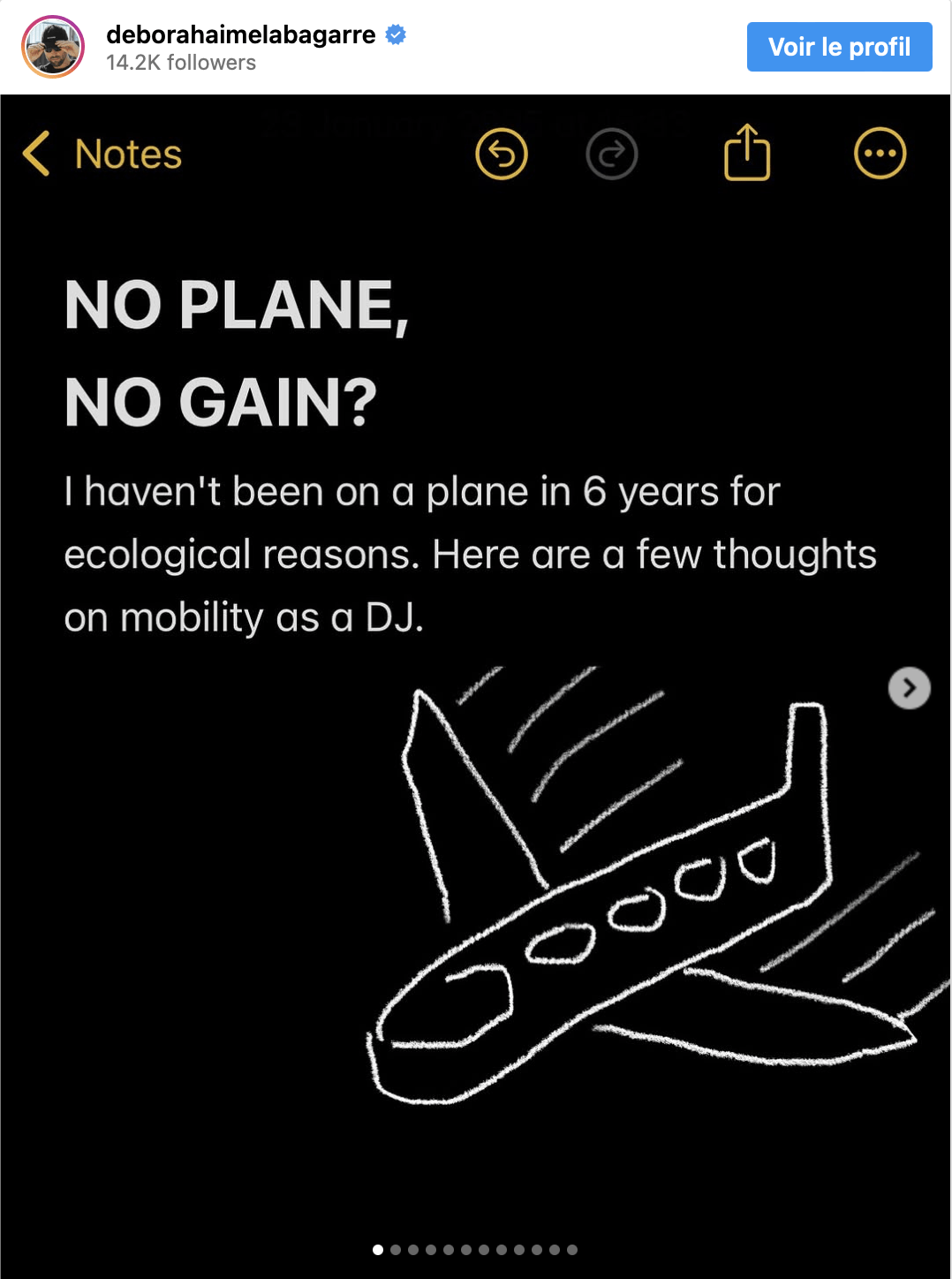
DJ and producer Deborah Aime La Bagarre made the decision seven years ago to stop flying for environmental and social reasons — a choice far from trivial in an era marked by the internationalization of DJ careers and the “fast life.”
Determined to stick to this position, even if it means turning down gigs all over the world, Deborah Aime La Bagarre continues to explore the margins of possibility in order to imagine more sustainable artistic practices.
Was there a precise moment when you told yourself: “I can’t take a plane anymore”? Was there a trigger?
On a long-haul business class flight, the cabin crew served me completely still water instead of lightly sparkling water — that was the last straw.
More seriously, after years of personal and collective commitment to social and environmental issues, I decided to stop one of the individual practices with the greatest impact on climate change: flying.
So I haven’t flown for either professional or personal reasons in seven years. Aviation actually represents almost the entirety of DJs’ carbon footprint*. It’s a work tool that is far from neutral, difficult to give up, and that embodies today’s growth-driven model.
I believe that partying is not only a space for personal fulfillment and consumption; it is also a political object that shapes our collective imagination and for which we are all responsible. The practices associated with it, its values, and the imagery these moments convey therefore deserve to be examined and questioned.
*17 times higher than the recommended individual carbon budget (Clean Scene Study, 2021).
Concretely, what has this choice cost you in terms of your career? Have you ever refused an opportunity that could have boosted your visibility?
Not flying doesn’t just mean taking the train more often — it also means choosing not to play far away despite demand. This choice affects my project in two main ways.
First, missed opportunities. Saying no to gigs also means saying no to experience, encounters, income, visibility, and networking. One summer, I said “no” in the same week to offers in Scotland, Turkey, and Brazil. That was not easy, to say the least.
And then there’s the hype factor. It’s very attractive for the French and European scene to show that a project is also in demand on the other side of the world. It’s more valued to say, “I played in Seoul yesterday” than “I’m playing in Saint-Jean-d’Angély tomorrow.” There’s an implicit rule that encourages travel: the farther an artist plays from home, the more recognized they seem.
It’s a refusal of success that comes at a cost, but it’s also an opportunity to connect more deeply with a scene and an audience that are sensitive to these issues — and therefore to build stronger bonds.
Is electronic music structurally incompatible with ecology today?
The common representation of the scene and its mainstream image seems incompatible with ecology: world tours, several countries per weekend, oversized stages and scenography, ultra fast life, gigantic festivals, and so on.
Fortunately, this concerns only a tiny fraction of artists. I’m convinced it’s possible to make a decent living from electronic music in other ways. There is a cultural battle to be fought to propose another vision of the scene — one not based on volume and performance.
I often see posts like “7h in Ibiza, what a trip,” and I worry about this kind of falsely desirable practice. To me, it’s a symptom of an ultra fast-life society that is harmful to artists’ mental health, the environment, and underground culture.
Even if the road is still long, we see more awareness than before. How would you assess the French electronic scene’s relationship to ecology today?
There are concrete initiatives moving in the right direction, and that’s very encouraging: Gogo Green, Mama Loves Ya, DJs for Climate Action, Bye Bye Plastic Foundation, Music Declares Emergency, ADE Green, and others.
There are also artists who take action and communicate about it thoughtfully, such as Simo Cell, Nono Gigsta, Esteban Desigual, and many committed venues and festivals.
Questioning the status quo is probably the most important step. Initiatives are multiplying, but the real difficulty lies in maintaining commitment while opportunities increase and careers grow within an ecosystem that encourages constant growth.
The good news is that I feel the audience is ready — and even ahead of the industry — when it comes to this change in perspective.
Saying “no” can be frustrating, but it’s also an opportunity to remind myself of everything I say “yes” to, and how lucky I am to live from this passion. And there’s plenty to do in Europe.
If the entire scene were to change tomorrow, what would a fair and sustainable touring system look like to you?
The goal is certainly not for everyone to do what I do, since each person commits according to their privileges, limitations, resources, and needs. But I aspire to a scene that is more sensitive to these issues — a scene where career choices are made consciously and where “yes” is not automatic.
Very concretely, here are a few ideas to move toward a more sustainable system:
- Choose the train for trips under 6–8 hours.
- Avoid or refuse one-off fly-in/fly-out gigs.
- Organize proper tours and maximize long-haul trips by creating local value (several gigs, workshops, studio time, etc.).
- Avoid glamorizing airplanes in photo/video content.
- Learn to say no to opportunities when it makes sense personally.
- Build stronger links between promoters to multiply gigs within the same region.
- Avoid or refuse venues and festivals that don’t align with your values.
- Promote local scenes.
And don’t wait for the scene to change before acting, or think you need to be perfect to speak about your commitments — that’s often a barrier people share with me. Every step in the right direction is still a step in the right direction.
Observing, discussing, and questioning existing practices with agencies, audiences, and peers is always useful. I also think programmers and bookers have a major role to play. Artists want to tour, agencies want their artists to tour as much as possible, and programmers can set a framework of values and extra-artistic practices so that events truly embody their vision.
Is the pursuit of hype and international expansion the direct enemy of ecological transition?
The omnipresence of a culture of hypergrowth in music is incompatible with ecological transition and with artists’ mental health. Today, an artist who does not grow (in volume) is seen as an artist who is falling behind. Stability is perceived as regression. Hence this implicit need to always do more. This “never enough” or “always more” often leads to a fleeting sense of fulfillment.
Do you ever feel marginalized or seen as “problematic” because of your refusal to fly?
Never — quite the opposite. Since I started talking about my commitments, I’ve only received support, especially from the public. People bring it up very often online and at my shows, and it creates very meaningful encounters.
It’s a counterintuitive gesture within today’s value system, but one that resonates with many people. The artists and the team around me are also sensitive to the issue and support me. Chevry, the agency that represents me, has been exemplary in this regard.
How does living in Paris make your commitment possible and easier?
Paris is the most connected city in the world to other major cities of culture and nightlife. London, Berlin, Brussels, Amsterdam, Barcelona, and dozens of others are less than eight hours away by train.
I used to describe living in Paris as a privilege, but I now see it as a choice — even a necessity. If I were flying, I probably wouldn’t be in Paris but back on the west coast where I come from. Today, I stay partly because it is necessary to maintain my commitments.
Everything I’m describing here is obviously incompatible with the lifestyle of an artist who cannot, for one reason or another, move geographically closer to a major European train hub.
Can you still be a “big” artist without being globalized?
To answer that, we first need to define what “big” means. Behind this term, often associated with quantity, I imagine many alternative criteria for defining whether an artist is “big”:
Is the artist recognized for the quality of their productions?
The originality of their universe?
Their exploration of a new subgenre?
Their commitment to the scene?
Their ability to build a community?
Their vision?
Their values?
For all of this, being globalized helps — but it is not mandatory. In any case, music now travels more than its creators do. It’s an endless topic.
Thanks to Dure Vie for their questions and for giving me the opportunity to express myself on these issues. To readers: I am always available to discuss these complex topics — I look forward to exchanging ideas there or elsewhere.
Interview by Adèle Chaumette